


QD or Direct Thread— Choosing the Right Suppressor Mounting System
Today, there are many different ways to mount a suppressor. One of the most common is direct-thread mounting, where the device is screwed directly onto the barrel’s threads. Another widespread approach is the use of QD (Quick Detach) systems, where a separate adapter or muzzle device remains on the barrel, and the suppressor locks onto it using a dedicated mechanism.
Both approaches have their advantages. The question is simply what problem you are trying to solve, so let’s take a closer look at choosing and using these systems.
Direct Thread: simplicity is king
In its simplest form, the system looks like this:
barrel → threads → suppressor.
No additional adapters, locking mechanisms, or moving parts.
This is one of the main advantages of direct-thread mounting. The fewer components there are between the barrel and the suppressor, the simpler the entire system becomes.
Fewer potential points of failure, fewer surfaces that can collect fouling or wear, and fewer maintenance requirements — especially under the harsh operating conditions of modern warfare, where operations resembling those of the world’s “special operators” — helicopter insertions followed by house-to-house clearing — are, to put it mildly, uncommon, and equipment has to withstand long periods of sustained use under load.

Lower Weight and Reduced Length
Every additional interface has a physical cost: it requires more material, which means more weight and length.
Depending on the design, QD systems may use dedicated muzzle devices and additional locking components.
For weapons where minimum weight and compactness matter, this can make a significant difference. Especially when that additional mass sits at the very end of the barrel, adding weight where it has the greatest effect instead of turning a handy short carbine back into something approaching a full-length rifle.
The further the mass is from the center of the weapon, the more strongly it affects the moment of inertia and the way the weapon feels when moving it or holding it at the ready — ultimately increasing shooter fatigue.

Fewer Interfaces — Fewer Tolerances
There is another advantage that is not always immediately obvious.
Every mechanical connection has manufacturing tolerances. When several components are connected in series, those tolerances can stack up.
With a direct-thread system, we essentially have one primary interface:
barrel → suppressor.
With a QD system, the architecture is more complex:
barrel → muzzle device/adapter → QD interface → suppressor.
This does not mean that QD systems are automatically less accurate. Well-made QD systems can provide excellent repeatability and concentricity. However, direct mounting has no intermediate interfaces, meaning there are fewer potential sources of tolerance stacking and fewer links in the system that can potentially fail.
Sometimes the best solution is not the mechanism that does more, but the mechanism that simply has fewer things that can prevent it from working.
So Why Use QD at All?
If direct mounting is so simple and effective, why use QD in the first place?
The answer is simple: speed and modularity.
A QD system allows you to install and remove a suppressor without having to screw it onto the threads every time — especially when the host muzzle device has its own useful characteristics, such as a muzzle brake, which can be very useful when suppressing the signature of fire is no longer a priority.
This is particularly useful when a single suppressor is used across multiple barrels.
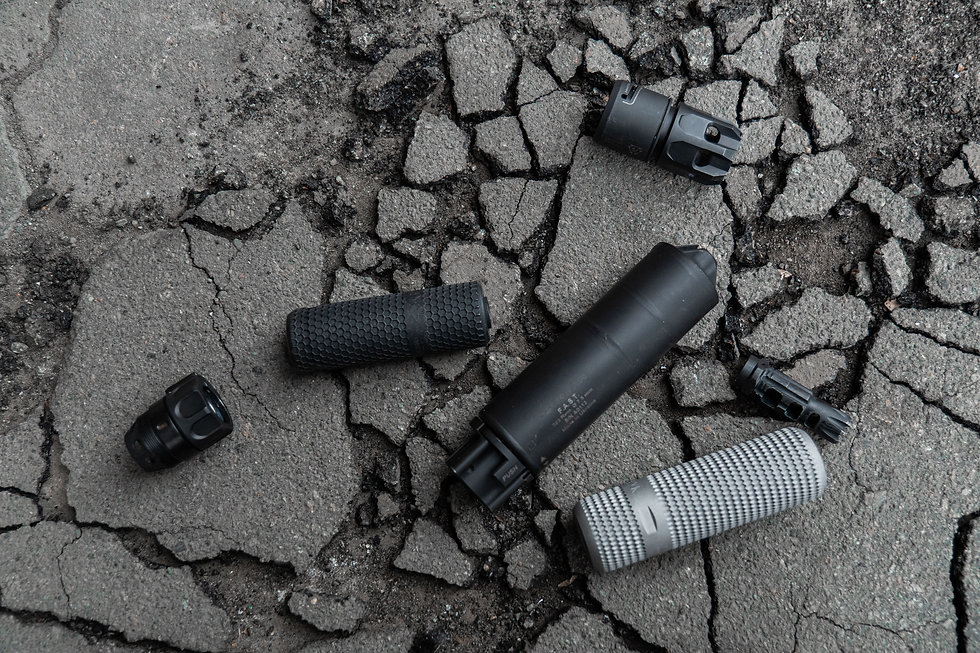
For example, each weapon can have its own muzzle device compatible with a particular QD interface. The suppressor itself can then be quickly moved from one platform to another.
That is exactly what QD was designed for.
In other words, QD is not a “better version of a thread.” It just solves a different problem.
Remaining Versatile
There is a price to being able to install and remove a suppressor quickly — and we are not talking about money.
An additional QD interface means:
more components;
additional weight;
increased overall dimensions;
greater mechanical complexity;
additional surfaces that require inspection and maintenance;
potential accumulation of manufacturing tolerances.
This is a classic engineering trade-off: the more functions a system has, the more complex it becomes.
If you need to move one suppressor quickly between multiple barrels, that complexity can be justified. This is particularly relevant to the U.S. firearms market, where until recently, acquiring a suppressor involved a lengthy and costly registration process for each individual suppressor. As a result, the market developed a wide range of modular suppressors and muzzle devices designed to allow multiple suppressors to be used across different caliber groups and multiple firearms in the same arsenal.
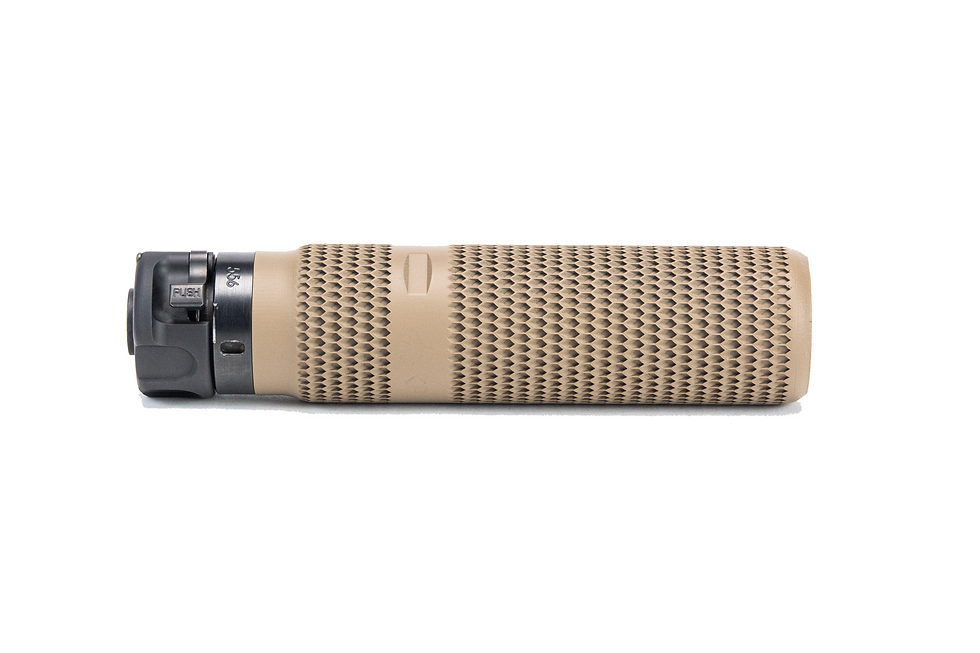
But if a suppressor is installed on one specific firearm and stays there, some of the advantages of QD simply stop making sense.
Where are you going to move your excellent Ase Utra or B&T without removing the muzzle device from the issued weapon? And are you really prepared to reinvest in the system just to continue using it on another platform?
But the Ukrainian market does not have those same restrictions; furthermore, what does any of this have to do with military use?
Quite a lot, actually.
Commercially developed devices and technologies are actively used by various military units and government agencies around the world. When developing their products, most manufacturers also bring their designs to a level where they are ready to compete in government military procurement programs. That means a sufficient level of quality, manufacturing precision, and reliability.
There is also another interesting and less frequently discussed — but fairly obvious — aspect of quick-detach systems: the concept itself is often misunderstood.
Quick Detach — or Quick Attach?
No matter how effective the cooling system is — like the systems used in KPYK devices — or how effectively heat is managed through frames, barriers, covers, and similar solutions, a muzzle device that contains the thermal energy of an entire shot will accumulate a very noticeable amount of heat, shot after shot, even within a single magazine.
If you can tolerate the heat and perhaps use heavy gloves, maybe even an additional heat-resistant grip, you may be able to unlock or unscrew the QD mechanism.
And if you have not fouled it up badly enough, you might even be able to remove the device from the muzzle device/barrel.
And then what?
What part of your gear — other than perhaps your sacrificial dump pouch — can safely hold something at 150–200°C or more? There is no packing time on the frontline to keep your rifle against the truck bed to cool it off.
This is the problem with QD systems: they can create a misleading idea that you can switch between a flash hider/muzzle brake and a suppressor whenever you want, depending on the situation.
But let’s be honest:
You started firing with the muzzle device exposed. Everyone who could hear you has already heard you, and hastily installing a suppressor afterward is not going to change that.
You are firing with a suppressor and decide to gain some efficiency and maneuverability by removing it and “opening up” the muzzle brake underneath. Chances are, you have bigger problems to deal with than changing the configuration of your muzzle device.
You plan to move without the extra weight on the barrel and install the suppressor when needed. But what happens if something goes wrong on the way? Will you actually have the time and opportunity to use that capability?
So perhaps it is more accurate to call these systems with mounting adapters not quick-detach, but quick-attach systems.
And that concept gives us several advantages that are actually practical and easier to understand.

Fast and Repeatable Installation
Using adapters and muzzle-device mounting systems allows the suppressor to be removed and installed easily without tools, which is particularly convenient when transporting the weapon — whether carried on your body, inside a case, or in a vehicle.
Furthermore, provided that the host muzzle device for the adapter is installed correctly and securely, the system can provide repeatable mounting.
So, Which One Is Better?
There is no single answer. And while we generally prefer devices that do not require an instruction manual longer than three steps, we still see clear advantages in both QD and HUB-compatible mounting systems — and recommend choosing based on what you actually need. The question should be: What do I gain from this mounting system?
If your priorities are:
minimum weight;
compactness;
simplicity;
reliable permanent installation;
then direct-thread mounting is the logical choice.
If your priorities are:
fast and repeatable installation;
the ability to use one suppressor on multiple barrels;
modularity;
rapid configuration changes;
then QD has obvious advantages.
Two Different Approaches to the Same Problem
Ultimately, direct thread and QD are not a battle between an “old” and a “new” technology.
They are two different ways of optimizing the same system.
Direct-thread mounting provides simplicity, minimum weight, and resistance to whatever circumstances fate decides to throw at you and your weapon.
QD optimizes the system for modularity, speed, and the ability to move a single suppressor between different platforms.
So the question is not which mounting system is better in general.
The question is whether you actually need the function you are paying for with additional complexity.
If a suppressor is going to remain on one specific barrel and do its job there, direct-thread mounting allows you to avoid adding something to the system that you simply do not need.
If, however, one suppressor needs to regularly move between different platforms, QD can justify its additional complexity through its primary advantage: rapid configuration changes.
Sometimes the best mounting system is the one that has nothing unnecessary in it. But when a quick-attach system is justified, make the most of its advantages.


Comments